Non-stick pans have revolutionized home cooking, turning tricky tasks like frying eggs and flipping pancakes into effortless kitchen moments. But beneath their smooth, easy-release surfaces lies a complex world of coating technology. Not all non-stick pans are created equal, and a key differentiator often comes down to their layered construction. Understanding whether a pan utilizes a 2-layer or 3-layer non-stick coating system is crucial for discerning cooks who prioritize durability, performance, and value. This guide will delve into the intricacies of these coating systems, comparing their benefits, drawbacks, and helping you decide which is the perfect match for your culinary adventures.
Understanding Non-Stick Coatings
At its core, a non-stick coating is designed to prevent food from adhering to the cooking surface. The most common and widely recognized non-stick material is Polytetrafluorofluoroethylene (PTFE), often known by the brand name Teflon. PTFE is prized for its extremely low friction coefficient and non-reactive properties, making it an ideal choice for cookware. However, the performance and longevity of a non-stick pan aren’t solely determined by the presence of PTFE, but by how this material, along with other components, is engineered into a multi-layered system.
The Anatomy of Non-Stick Coatings: Why Layers Matter
The quality and durability of a non-stick coating significantly improve with a multi-layered structure. While the simplest coatings consist of just one non-stick layer, higher quality systems incorporate several distinct layers, each serving a specific purpose to enhance the pan’s overall resilience and performance.
- Primer Layer: This foundational layer is applied directly to the pan’s metal base (often aluminum or stainless steel). Its primary role is to improve adhesion, creating a strong bond between the non-stick system and the cookware material. Without a robust primer, the entire coating is prone to peeling and flaking prematurely.
- Mid-Coat (Reinforcement Layer): Present in multi-layer systems, this intermediate layer is a game-changer for durability. It often contains internal reinforcements, such as tiny hard ceramic or mineral particles. These particles enhance the connection between individual layers and significantly boost resistance to abrasion and scratches, protecting the core non-stick properties from daily wear and tear.
- Top-Coat (Non-Stick Layer): This is the outermost layer, responsible for the pan’s excellent food release properties. It typically contains a higher concentration of PTFE and provides the smooth, slick finish that prevents food from sticking, ensuring easy cooking and cleaning. This layer also contributes to the aesthetic finish of the pan.
2-Layer Non-Stick Coating Systems
A 2-layer non-stick system generally consists of a primer layer and a topcoat. This straightforward construction offers a balance of functionality and affordability.
The primer layer ensures the coating adheres effectively to the pan’s surface, while the subsequent non-stick topcoat provides the essential food release. Pans with a 2-layer system are often more cost-effective, making them an accessible option for many kitchens. They deliver good initial non-stick performance, making them suitable for everyday cooking tasks such as frying eggs, making pancakes, or sautéing delicate vegetables that don’t require aggressive stirring or high heat.
However, the absence of a dedicated reinforcing mid-coat means that 2-layer systems are generally less durable than their multi-layered counterparts. They are more susceptible to scratches and abrasion from metal utensils or vigorous cleaning, which can lead to premature wear and a shorter overall lifespan. For cooks seeking maximum longevity or who anticipate heavier use, a 2-layer system might require more careful handling.
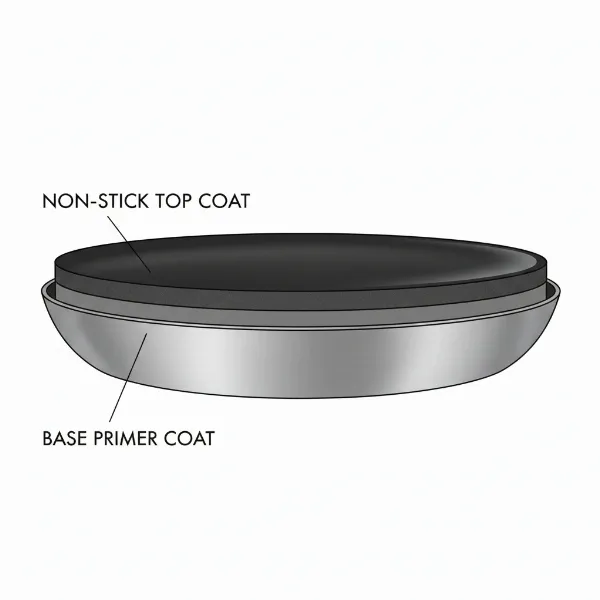 Illustration of a 2-layer non-stick pan coating system with primer and topcoat.
3-Layer Non-Stick Coating Systems
The 3-layer non-stick system represents an advancement in non-stick technology, incorporating a primer, a reinforced mid-coat, and a topcoat. This extra intermediate layer is specifically engineered to bolster the coating’s resilience and extend its working life.
The addition of a mid-coat, often infused with hard ceramic or mineral particles, provides internal reinforcement, creating a tougher barrier against scratches and abrasion. This makes 3-layer coatings significantly more durable and resistant to wear and tear from common kitchen utensils. Consequently, pans with 3-layer systems typically boast a longer lifespan and maintain their non-stick properties more effectively over time compared to 2-layer options. This enhanced durability allows for a wider range of cooking applications and offers greater peace of mind for those who value longevity and consistent performance. While these pans usually come with a higher price tag, the increased durability and extended performance often justify the investment for serious home cooks and busy families.
> “The multi-layered approach to non-stick coatings, especially with an integrated reinforcement layer, isn’t just about adding thickness; it’s about engineering a composite structure that significantly improves resistance to mechanical wear and enhances the overall lifespan of the cookware.” – Chef Antoine Dubois, Culinary Technology Expert
Direct Comparison: 2-Layer vs. 3-Layer Non-Stick
When choosing between a 2-layer and a 3-layer non-stick coating system, understanding their core differences is key. Here’s a direct comparison to highlight their characteristics:
| Feature | 2-Layer Non-Stick Coating | 3-Layer Non-Stick Coating |
|---|---|---|
| Composition | Primer layer + Top non-stick layer | Primer layer + Reinforced mid-coat + Top non-stick layer |
| Durability | Moderate; more prone to wear and abrasion | High; significantly enhanced resistance to wear and tear |
| Scratch Resistance | Moderate; susceptible to scratches from metal utensils | High; reinforced mid-coat provides superior protection |
| Non-Stick Performance | Good initial performance | Excellent and more consistent over time |
| Lifespan | Shorter (typically 1-3 years with regular use) | Longer (can double or triple the lifespan of single-layer systems) |
| Cost | More budget-friendly, entry-level to mid-range | Higher, reflecting enhanced durability and technology |
| Recommended Use | Light to moderate cooking, delicate foods | Everyday heavy use, wider range of cooking styles |
This table illustrates that while 2-layer systems offer a good starting point, 3-layer systems provide a robust upgrade in terms of resilience and longevity, which can be a significant factor for frequent cooks.
Choosing the Right Non-Stick Pan for Your Kitchen
Selecting the ideal non-stick pan involves more than just picking a pretty piece of cookware; it’s about aligning its features with your specific cooking needs and lifestyle.
First, consider your cooking frequency and style. If you cook occasionally or primarily use your non-stick pan for delicate items like eggs and fish, a high-quality 2-layer system might suffice, offering great non-stick release without overspending. However, for daily cooking, rigorous stirring, or if you prefer the flexibility of occasionally using metal utensils (though non-metallic are always recommended for maximum longevity), a 3-layer non-stick pan is a more suitable and durable investment.
Next, factor in your budget. While 3-layer pans come at a higher price point, their extended lifespan and superior durability can translate into better long-term value, as you won’t need to replace them as frequently. Conversely, 2-layer pans are an excellent choice for those seeking efficient non-stick cooking on a tighter budget. Always inspect the pan for any surface imperfections before purchase, and check for a sturdy, comfortable handle and a flat base compatible with your stovetop type (e.g., induction).
Maximizing the Lifespan of Your Layered Non-Stick Pan
Regardless of whether you choose a 2-layer or 3-layer non-stick pan, proper care and maintenance are paramount to extending its lifespan and preserving its non-stick properties.
Always use non-metallic utensils such as wood, silicone, or plastic to avoid scratching the delicate coating, even on highly reinforced 3-layer systems. Scratches are the primary cause of non-stick coating degradation. Avoid overheating your pan; non-stick coatings, especially PTFE, can degrade rapidly when exposed to temperatures above 260°C (500°F). Use medium heat for most cooking, and never preheat an empty non-stick pan on high heat.
When cleaning, allow the pan to cool completely before washing it by hand with warm, soapy water and a soft sponge. Harsh abrasive scrubbers or metal scouring pads can damage the surface. While some non-stick pans are advertised as dishwasher-safe, hand washing is generally recommended to preserve the coating over time. Proper storage, where pans are not stacked directly on top of each other without protection (like pan protectors or paper towels), also helps prevent accidental scratches.
Beyond Layers: Other Factors Influencing Non-Stick Quality
While the number of non-stick layers is a significant indicator of quality, other factors also play a crucial role in a pan’s overall performance and durability. The base material of the pan (e.g., aluminum for even heating, stainless steel for induction compatibility), the quality of the PTFE itself, and the precision of the manufacturing process all contribute to the final product.
Modern non-stick coatings are generally considered safe, with most reputable brands offering products free from PFOA (perfluorooctanoic acid) and PFOS (perfluorooctanesulfonic acid), which were chemicals historically used in the manufacturing process and raised health concerns. Always look for certifications or clear labeling regarding PFOA/PFOS-free status. Ultimately, a combination of superior layering, quality materials, and responsible manufacturing creates a non-stick pan that not only performs exceptionally but also offers peace of mind.
Conclusion
The choice between 2-layer and 3-layer non-stick coating systems is a fundamental decision that impacts your cooking experience and the longevity of your cookware. While 2-layer systems offer an affordable entry into convenient non-stick cooking, delivering good initial performance for lighter use, 3-layer systems stand out for their significantly enhanced durability, superior scratch resistance, and extended lifespan. The reinforced mid-coat in a 3-layer system provides an invaluable protective barrier, making it a more robust and enduring option for frequent cooks and demanding kitchen environments. Investing in a pan with a higher-quality, multi-layered coating, coupled with diligent care, ensures that you’ll enjoy effortless cooking and easy cleanup for years to come. Consider your cooking habits, budget, and desired lifespan to make an informed decision that elevates your culinary journey. Which layered system will best serve your kitchen needs?
Frequently Asked Questions
Is 3-layer non-stick always better than 2-layer?
|
Our Picks for the Best Non stick pan in 2026
As an Amazon Associate I earn from qualifying purchases.
|
||
| Num | Product | Action |
|---|---|---|
| 1 | Tramontina Professional 8-Inch Non Stick Small Frying Pan, Heavy-Gauge Aluminum Skillet with Reinforced Nonstick Coating, Red Handle, Dishwasher and Oven Safe |

|
| 2 | Tramontina Professional 10-Inch Non Stick Frying Pan, Heavy-Gauge Aluminum Skillet with Reinforced Nonstick Coating, Red Handle, Dishwasher and Oven Safe |
|
| 3 | SENSARTE Nonstick Frying Pan Skillet, Swiss Granite Coating Omelette Pan, Healthy Stone Cookware Chef's Pan, PFOA Free (9.5 Inch) |
|
| 4 | SENSARTE Nonstick Frying Pan Skillet with Lid, 12 Inch Large Deep Frying Pan, 5 Qt Non Stick Saute Pan with Cover, Induction Pan, Healthy Non Toxic Cooking Pan with Helper Handle, PFOA PFOS Free |
|
| 5 | CAROTE Nonstick Frying Pan Skillet,Non Stick Granite Fry Pan Egg Pan Omelet Pans, Stone Cookware Chef's Pan, PFOA Free,Induction Compatible(Classic Granite, 8-Inch) |
|
| 6 | Non Stick Frying Pans, 12-inch with Lid, Hybrid Fajita Pans Nonstick,non stick Skillets Stainless Steel, Dishwasher & Oven-Safe, Induction Compatible Cooking Pan, PFOA Free Cookware |
|
| 7 | SENSARTE Nonstick Frying Pan Skillet, Swiss Granite Coating Omelette Pan, Healthy Stone Cookware Chef's Pan, PFOA Free (8/9.5/10/11/12.5 Inch) (8 Inch) |
|
| 8 | GoodCook Nonstick Sauté Pan, 10 Inch, Black |
|
| 9 | Blue Diamond 10" Nonstick Frying Pan Skillet, Diamond Infused PFAS & PTFE-Free Ceramic Pot, Dishwasher & Oven Safe, Stay Cool Handle, Durable Non Toxic Metal Utensil Safe, Egg & Omelet Pan, Blue |
|
| 10 | SENSARTE Nonstick Skillet, Deep Frying Pan 10/11/12-inch, Saute Pan with Lid, Stay-cool Handle, Healthy Stone Cookware Cooking Pan, Induction Compatible (10-Inch/3.5QT) |
|
Generally, 3-layer non-stick coatings are considered superior in terms of durability, scratch resistance, and longevity due to the added reinforced mid-coat. While 2-layer systems offer good initial non-stick performance and are more budget-friendly, they tend to wear out faster with regular use.
How can I tell if a pan has 2 or 3 layers?
Manufacturers typically advertise the number of non-stick layers as a key feature, especially for 3-layer systems, due to their enhanced durability. Check the product description, packaging, or the manufacturer’s website for specific details on the coating construction. Often, higher-priced pans from reputable brands indicate a multi-layer system.
What is the lifespan difference between 2-layer and 3-layer non-stick?
A single-layer or basic 2-layer non-stick coating might last 1-3 years with regular use before significant degradation. A well-maintained 3-layer system, however, can easily double or triple that lifespan, offering several years of consistent non-stick performance due to its reinforced design.
Are multi-layer non-stick coatings safer?
The safety of non-stick coatings primarily depends on avoiding overheating and ensuring they are PFOA/PFOS-free. Both 2-layer and 3-layer systems from reputable brands are generally safe when used correctly. The multi-layer system’s increased durability means the coating is less likely to degrade and release particles prematurely, potentially offering a longer period of safe use.
Can I use metal utensils on 3-layer non-stick?
While 3-layer non-stick coatings offer superior scratch resistance due to their reinforced mid-coat, it is still strongly recommended to use wooden, silicone, or plastic utensils. Metal utensils, even on the most durable coatings, can eventually cause micro-scratches that compromise the non-stick surface over time, shortening the pan’s overall lifespan.